Gemnigen AI: A Complete Guide to Features, Uses, Benefits, and Safety
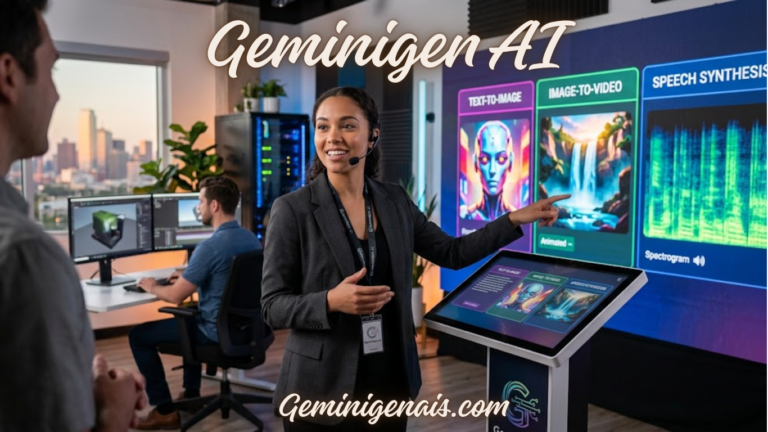
If you searched for gemnigen ai, you may actually be looking for GeminiGen AI, a generative AI platform associated with AI-powered image, video, speech, and text generation. Because the spelling “gemnigen” appears to be a common variation of the name, it is useful to understand the platform under the name GeminiGen AI and verify the exact website before creating an account or entering payment information.
Public documentation associated with GeminiGen describes tools for generating content from prompts, including image and video generation, while its API documentation also describes text generation and model-based controls.
This guide explains what gemnigen ai means, how GeminiGen AI works, what features are associated with it, possible use cases, limitations, privacy and security considerations, pricing considerations, and what users in the United States should check before relying on any AI-generated output.
What Is Gemnigen AI?
The term gemnigen ai generally appears to be a misspelled or shortened search query for GeminiGen AI. GeminiGen AI is presented online as a generative AI platform designed to help users create different types of digital content.
Depending on the tool or service being used, the platform has been associated with:
- AI-generated images
- AI-generated videos
- AI-generated speech
- AI-generated text
- Image-to-video workflows
- Text-to-video generation
- Developer APIs
- Multiple AI models
- Prompt-based content creation
Its public API documentation describes an interface where developers can send a prompt and receive generated text, with options involving model selection and a thinking budget. Other GeminiGen documentation describes image and video generation APIs.
This distinction matters because “gemnigen ai” is not necessarily the official spelling of a separate AI product. Searchers should check the actual domain and service name before assuming that every website using the phrase is affiliated with the same company.
Why Are People Searching for Gemnigen AI?
People searching for gemnigen ai may have several different intentions.
Some users may simply want to know what the platform does. Others may be looking for an AI image generator, video generator, text generator, or an API for adding generative AI to another application.
The search can therefore represent several needs:
- Understanding GeminiGen AI
- Finding an AI content generator
- Creating images from text prompts
- Creating videos with AI
- Exploring AI voice or speech generation
- Comparing different AI models
- Finding an API
- Understanding pricing
- Checking whether the service is safe
- Learning whether generated content can be used commercially
This broad search intent means that users should not judge the service from a single feature or advertisement. AI platforms can change their models, prices, features, and availability over time.
How Does GeminiGen AI Work?
At a basic level, a generative AI service takes an instruction from the user and sends it to an AI model.
For example, a user might provide an instruction such as:
“Create a realistic image of a modern American city at sunset.”
The system interprets the prompt and uses a compatible generative model to create an output.
For text generation, the process can be similar. A user provides a written instruction and receives generated text.
For image or video generation, the prompt can describe things such as:
- Subject
- Location
- Lighting
- Camera angle
- Visual style
- Movement
- Aspect ratio
- Resolution
- Mood
The quality of the final result depends on several factors. These include the selected model, prompt quality, available computing resources, input material, and the specific capabilities of the model.
GeminiGen’s public documentation shows that its API ecosystem can involve model selection and parameters such as temperature and thinking budget for text-generation workflows.
What Can You Create With Gemnigen AI?
One reason the term gemnigen ai attracts attention is its connection with several types of generative content.
AI Images
AI image generation allows users to describe a visual idea and receive an image based on that description.
Possible uses include:
- Blog illustrations
- Social media graphics
- Concept art
- Marketing concepts
- Product ideas
- Presentation visuals
- Educational illustrations
- Creative experiments
Public GeminiGen documentation describes an image-generation API and identifies multiple image models and image-generation capabilities.
However, generated images should always be reviewed before publication. AI systems can create incorrect text, distorted objects, unusual hands, inaccurate logos, or other visual mistakes.
AI Video
AI video generation is another important part of the GeminiGen ecosystem.
Public documentation associated with GeminiGen describes video generation using models such as Veo and other video-generation systems. It also describes workflows involving text-to-video and image-to-video generation.
A simple workflow can look like this:
- Write a video idea.
- Describe the scene.
- Select a model.
- Choose output settings.
- Generate the video.
- Review the result.
- Make changes.
- Export the final version.
AI video tools can reduce the amount of traditional production work required for certain projects, but they do not remove the need for editing and quality control.
AI Speech
Some public listings associate GeminiGen AI with AI speech generation and voice-related content.
Speech generation can be useful for:
- Narration
- Educational videos
- Demonstrations
- Podcasts
- Marketing content
- Voiceover drafts
Users should be careful with voice cloning or attempts to imitate real people. Permission, identity rights, platform rules, and applicable laws can become important when a recognizable person’s voice is involved.
AI Text Generation
GeminiGen’s public API documentation also describes a text-generation endpoint. The documentation states that users can submit prompts and receive generated responses, with model and generation controls.
Text generation can help with:
- Brainstorming
- Drafting
- Summarizing
- Rewriting
- Research assistance
- Coding assistance
- Content planning
Generated text should not automatically be treated as factual. AI models can produce incorrect information even when the response sounds confident.
Gemnigen AI and Multiple AI Models
One feature associated with modern AI platforms is the ability to access different models through a single interface.
This can be useful because different models may perform differently on different tasks.
For example, one model might be better suited to:
- Fast responses
Another may be better for:
- Complex reasoning
A different model might focus on:
- Image generation
And another may specialize in:
- Video generation
GeminiGen’s public repositories describe multi-model image and video workflows and reference models from different AI providers.
For users, the important point is that the platform name does not necessarily mean every output is produced by one single underlying model.
What Is the GeminiGen AI API?
An API, or application programming interface, allows one software system to communicate with another.
Instead of opening an AI website manually, a developer can connect an application to an AI service.
GeminiGen’s public API documentation describes endpoints for content generation and authentication using an API key.
An API can be useful for businesses or developers that want to automate tasks such as:
- Generating text
- Creating images
- Producing video
- Building content workflows
- Connecting AI to an internal application
- Creating automated production systems
For example, a company could build a content management system that sends approved prompts to an AI API.
The developer would normally control the input, authentication, output handling, and application logic.
How Developers Can Use Gemnigen AI
Developers should understand the difference between an AI website and an AI API.
A website is designed for people.
An API is designed for software.
A typical API workflow may involve:
- Creating an account.
- Obtaining an API key.
- Reading the API documentation.
- Sending an authenticated request.
- Providing the required prompt or input.
- Receiving the generated result.
- Processing the response in an application.
The public GeminiGen text API documentation gives examples involving an API key, a text-generation endpoint, model parameters, and file inputs.
API users should never publish private API keys inside public source code or repositories.
What Are the Main Benefits of Gemnigen AI?
The usefulness of GeminiGen AI depends on the task, but several potential benefits explain why multi-modal AI platforms are popular.
Faster Content Creation
AI can produce an initial draft much faster than starting every project manually.
This can be particularly useful during brainstorming.
Multiple Content Types
A platform that supports several types of generation can simplify workflows.
Instead of using separate tools for every task, users may be able to experiment with text, images, video, or speech in related workflows.
Experimentation
Generative AI makes it easy to create multiple variations.
A designer can test several visual ideas before deciding which concept deserves more manual work.
Automation
APIs can connect AI generation to other software.
This can be useful for organizations that create large amounts of repetitive content.
Accessibility for Beginners
Prompt-based systems allow people without advanced design or video-production skills to experiment with generative content.
That does not mean the results will always be professional, but it can lower the initial barrier to experimentation.
What Are the Limitations of Gemnigen AI?
AI tools are not perfect, and users should understand their limitations before depending on them.
AI Can Make Mistakes
A generated answer can contain incorrect facts.
An image can contain visual errors.
A video can contain inconsistent movement.
A voice generation system can mispronounce words.
Human review remains important.
Results Can Vary
Two similar prompts may not produce identical results.
The selected model, settings, available capacity, and prompt wording can all affect the output.
Complex Instructions May Need Several Attempts
A single prompt does not always produce the desired result.
Users often need to revise:
- Wording
- Style
- Composition
- Length
- Camera instructions
- Reference images
- Output settings
AI Does Not Replace Expertise
An AI tool can help create a draft, but professional judgment is still necessary.
A doctor, lawyer, teacher, engineer, marketer, or journalist may need to verify AI-generated information against authoritative sources before using it.
Is Gemnigen AI Free?
The answer can change over time, so users should check the current pricing information on the service before making a payment.
Third-party listings have described different access models, including free access and credit-based or paid generation. One current third-party listing describes credit-based usage and points users toward GeminiGen’s pricing page for the latest information.
This is an area where users should be particularly careful.
A “free” AI tool may mean:
- Free account registration
- Limited generations
- Free credits
- Trial access
- Lower-resolution output
- Limited models
- Watermarked output
Therefore, “free” does not always mean unlimited use without payment.
How Does AI Credit Pricing Work?
Many generative AI services use credits instead of a simple monthly subscription.
For example, a platform may charge different amounts depending on whether you generate:
- Text
- One image
- A high-resolution image
- A short video
- A longer video
- Speech
- A premium-model output
Video generation can be particularly expensive because producing moving images requires substantially more computing resources than generating a short text response.
Before purchasing credits, users should check:
- Cost per generation
- Credit expiration rules
- Refund policy
- Subscription terms
- Automatic renewal
- Premium-model costs
- Failed-generation policies
These details can be more important than the advertised headline price.
Is Gemnigen AI Safe to Use?
Safety depends on how the service is used and what information a user provides.
There is no single answer that makes every AI platform completely safe or unsafe.
Users should evaluate the service using several factors.
First, confirm that you are visiting the intended website.
Second, review the platform’s privacy policy and terms.
Third, avoid uploading highly sensitive information unless you understand exactly how it will be handled.
Fourth, use strong account security.
Fifth, carefully review billing terms before purchasing credits.
Public user-review platforms contain both positive and negative reports about GeminiGen, including complaints concerning availability, generation failures, and paid access. These are individual user reports rather than independent proof that every user’s experience will be the same, but they are still useful signals to investigate before spending money.
What Privacy Risks Should Users Consider?
Privacy is one of the most important issues when using any generative AI service.
A prompt may seem harmless, but uploaded files can contain much more information than the user realizes.
For example, a photograph may contain:
- Faces
- Addresses
- Documents
- Location information
- Screens
- Personal belongings
- Metadata
A document may contain:
- Names
- Phone numbers
- Financial information
- Business information
- Confidential material
Before uploading anything sensitive, users should understand the platform’s data practices.
Important questions include:
- How long is uploaded content retained?
- Is content used to improve models?
- Who can access uploaded files?
- Can users delete their data?
- What happens when an account is closed?
- Are third-party AI models involved?
- Where is data processed?
These questions are more useful than simply asking whether an AI website is “safe.”
Should You Upload Private Documents to Gemnigen AI?
Users should avoid uploading confidential documents unless they have verified the platform’s handling policies and have a legitimate reason to do so.
For example, users should think carefully before uploading:
- Government identification
- Tax documents
- Bank statements
- Private medical records
- Confidential contracts
- Passwords
- API keys
- Customer databases
The same principle applies to any cloud-based AI service, not just GeminiGen.
A good rule is simple: if you would not normally send a document to an unfamiliar online service, do not upload it simply because an AI tool asks for it.
Can Gemnigen AI Content Be Used for Business?
AI-generated content can potentially support business work, but commercial use depends on the platform’s current terms and the rights associated with the underlying content.
Businesses should review the applicable terms before using generated material in:
- Advertisements
- Websites
- Product packaging
- Client projects
- Paid social campaigns
- Commercial videos
- Branding
Another important issue is third-party intellectual property.
For example, asking an AI system to imitate a protected brand, reproduce copyrighted artwork, or generate an image of a recognizable person can raise separate legal or contractual questions.
AI generation does not automatically remove those issues.
Can AI-Generated Content Be Copyrighted?
Copyright treatment of AI-generated content is a complicated legal topic in the United States.
The important point for ordinary users is that simply generating something with AI does not automatically guarantee the same copyright protection as human-created work.
The exact legal outcome can depend on factors such as:
- Human creative contribution
- How the work was created
- The nature of the final material
- Applicable copyright law
- Decisions from courts and government agencies
Businesses should therefore avoid assuming that every AI-generated image or video automatically receives strong copyright protection.
For important commercial projects, professional legal advice may be appropriate.
How to Get Better Results From Gemnigen AI
Good prompts generally provide more useful direction than vague prompts.
Instead of writing:
“Make a city.”
A more specific prompt might describe:
- The location
- Time of day
- Visual style
- Camera perspective
- Lighting
- Main subject
- Mood
- Intended format
For example:
“Create a realistic downtown American city scene at sunset, viewed from street level, with warm natural lighting, moderate pedestrian activity, and a clean editorial photography style.”
The second instruction gives the model much more information.
Start With the Main Idea
First explain what you want.
Add Visual Details
Describe appearance, environment, lighting, and composition when generating images or videos.
Define the Audience
For commercial work, explain who the content is intended for.
Specify the Format
Mention whether the content is intended for:
- Website
- YouTube
- Presentation
- Advertisement
- Blog
Revise Instead of Starting Over
If the first result is close, improve the prompt rather than completely abandoning it.
This is one of the most effective ways to work with generative AI.
Common Mistakes When Using Gemnigen AI
Beginners often make several mistakes.
Using Very Short Prompts
Short prompts can work, but they provide less control.
Expecting Perfect Results on the First Try
Generative AI is often an iterative process.
Trusting AI Facts Without Checking
A polished response can still be wrong.
Uploading Sensitive Files
Convenience should not override privacy.
Ignoring Commercial Rights
A generated image may involve third-party intellectual property or platform-specific licensing rules.
Forgetting About Costs
Repeated video generation can consume credits quickly.
Sharing API Keys
An exposed API key can potentially allow unauthorized use of an account or paid resources.
Who Can Benefit From Gemnigen AI?
GeminiGen AI may be useful to several groups.
Content Creators
Creators can experiment with visual concepts, videos, narration, and written drafts.
Social Media Managers
AI can help create variations for different platforms and campaigns.
Small Businesses
Small companies may use generative tools for early marketing concepts without immediately hiring a full production team.
Designers
Designers can use AI outputs as inspiration or starting points.
Developers
Developers may benefit from API access when building automated workflows.
Educators
Teachers and students can use generative AI for brainstorming and visual explanations, provided that factual information is checked.
Who Should Be More Careful?
AI generation may require extra caution for users working with sensitive information.
This includes:
- Healthcare organizations
- Financial companies
- Legal professionals
- Government organizations
- Businesses handling confidential customer information
- Companies with strict intellectual-property requirements
In these environments, an AI service should be evaluated not only for creative quality but also for privacy, security, compliance, contractual terms, and data governance.
Gemnigen AI vs Traditional Content Creation
Traditional content creation usually involves people using dedicated tools to perform individual tasks.
For example, a video project might require:
- Scriptwriting
- Filming
- Voice recording
- Editing
- Graphics
- Color correction
- Sound design
Generative AI can potentially shorten some of these steps.
However, this does not mean traditional production is obsolete.
Human creators remain important for:
- Creative direction
- Fact checking
- Brand consistency
- Editorial judgment
- Legal review
- Quality control
- Final editing
The strongest workflow may therefore be a combination of AI assistance and human expertise.
What Should U.S. Users Know About Gemnigen AI?
For users in the United States, several practical issues deserve attention.
First, check the platform’s current terms rather than relying on old articles.
Second, understand the payment system before buying credits.
Third, read the privacy policy before uploading personal information.
Fourth, verify commercial-use rights for business projects.
Fifth, do not assume that AI-generated information is accurate simply because it is presented confidently.
Finally, keep records of important AI-assisted work when it is being used professionally. Saving prompts, source material, editing history, and final human revisions can help explain how a piece of content was produced.
What Does Gemnigen AI Mean for Digital Literacy?
Generative AI has made digital literacy more important, not less.
In the past, users mainly needed to know how to search for information.
Now they also need to understand how AI creates information.
A responsible AI user should ask:
- Where did this information come from?
- Can I verify it?
- Is the image authentic?
- Could the voice be synthetic?
- Is the video AI-generated?
- Does the content contain errors?
- Who owns the underlying material?
- What personal data am I sharing?
These questions help users distinguish between content that looks convincing and content that has actually been verified.
How Should Businesses Evaluate Gemnigen AI?
Businesses should look beyond the number of available AI models.
A useful evaluation process can include:
Output Quality
Generate the same type of content several times and examine consistency.
Reliability
Check whether the service is available when you need it.
Cost
Calculate the real cost of producing your normal monthly workload.
Privacy
Review data handling and retention policies.
Security
Check account security and API-key practices.
Licensing
Understand the rights attached to generated content.
Support
Determine how the company handles technical and billing problems.
Integration
For developers, review API documentation and integration requirements.
This provides a much more realistic assessment than judging an AI platform from promotional screenshots.
What Is the Future of Platforms Like Gemnigen AI?
AI content platforms are moving toward increasingly integrated workflows.
Instead of using separate applications for writing, image generation, video production, voice generation, and editing, users may increasingly work inside a single AI-assisted environment.
The important development is not simply better AI output.
The larger change is the combination of:
- Multiple models
- Automated workflows
- APIs
- Image generation
- Video generation
- Speech generation
- Editing
- Collaboration
GeminiGen’s public repositories already show this direction through multi-model image and video tools and developer APIs.
At the same time, users will continue to face questions about authenticity, copyright, privacy, cost, and responsible AI use.
Is Gemnigen AI the Same as Google Gemini?
Not necessarily.
This is an important distinction.
The word “Gemini” can refer to Google’s Gemini family of AI models and products, while GeminiGen AI is a separate platform that presents AI generation tools and APIs.
Public GeminiGen documentation references models from different providers and describes its own generation platform.
Therefore, users should not assume that a website containing the word “Gemini” is automatically an official Google service.
Always verify the domain, company information, terms, and documentation before entering an account or payment information.
What Should You Check Before Using Gemnigen AI?
A simple checklist can help:
- Confirm the correct website.
- Read the current pricing page.
- Check whether credits expire.
- Review subscription terms.
- Read the privacy policy.
- Check commercial-use conditions.
- Avoid uploading sensitive information.
- Protect API keys.
- Test output quality before purchasing heavily.
- Verify important AI-generated facts.
- Keep human oversight for professional work.
This approach is useful for almost any generative AI platform.
Frequently Asked Questions About Gemnigen AI
Is Gemnigen AI an AI generator?
Gemnigen AI appears to refer to GeminiGen AI, a platform associated with generative AI services. Public documentation describes text, image, video, and other AI-generation capabilities, although the exact available features can change over time.
Can Gemnigen AI generate videos?
Yes, GeminiGen’s public documentation describes AI video-generation tools and APIs, including text-to-video and image-to-video workflows.
Does Gemnigen AI have an API?
Yes. Public GeminiGen documentation describes API access for AI generation and provides documentation for authenticated requests.
Can businesses use GeminiGen AI?
Businesses can potentially use generative AI tools for content production, marketing, development, and other workflows. However, companies should check current licensing, privacy, commercial-use, and contractual terms before using generated content commercially.
Is everything created by GeminiGen AI automatically accurate?
No. AI-generated content can contain factual, visual, technical, or contextual errors. Important information should be checked against reliable sources before publication or professional use.
Conclusion
Gemnigen AI appears to be a search variation for GeminiGen AI, a generative AI platform associated with tools for creating text, images, videos, speech, and other digital content. Public documentation also shows an API ecosystem designed for developers who want to integrate AI generation into software applications.
The main attraction of a platform like GeminiGen AI is convenience. Users can describe an idea and use AI models to create an initial result much faster than many traditional workflows allow. Creators, marketers, developers, educators, and businesses can potentially use these capabilities for brainstorming, content production, automation, and experimentation.
However, speed should not be confused with reliability. AI-generated material still needs human review. Users should verify facts, inspect images and videos for errors, understand licensing conditions, and avoid sharing sensitive information without first checking how the platform handles data.
For U.S. users, the most practical approach is to treat Gemnigen AI as a tool rather than an authority. Its value depends on the specific task, the model being used, the cost, the quality of the output, and the amount of human oversight applied. Checking current terms and documentation before relying on the service is especially important because AI platforms can change their models, features, pricing, and policies over time.